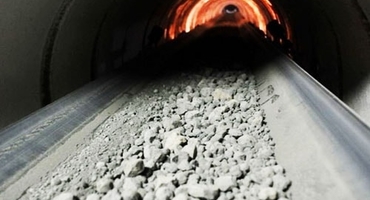
Portland cement manufacturing involves the following technological stages: raw materials extraction; raw meal preparation and preheating, clinker burning, and cement grinding with additives. There are several methods of Portland cement manufacturing: wet, dry, semi-dry, and combined depending on how raw materials are mixed and prepared for burning. In the wet process the raw materials are crushed with the addition of water. The components are mixed and ground to a fine consistency of slurry which is a liquid creamy substance with water content of about 32-50%. After that, the slurry is pumped to the rotary kiln. In the dry process, the raw materials are reduced to a very fine powder known as raw meal. The raw meal is blended, corrected, and fed to the rotary kiln for burning.
Advantages of industrial automation integration:
- improved quality of clinker
- possibility to use any type of fuel: natural gas, oil fuel, coal;
- lower fuel consumption;
- higher productivity of the kiln;
- lower emission of waste gases and nitrogen oxides in particular.
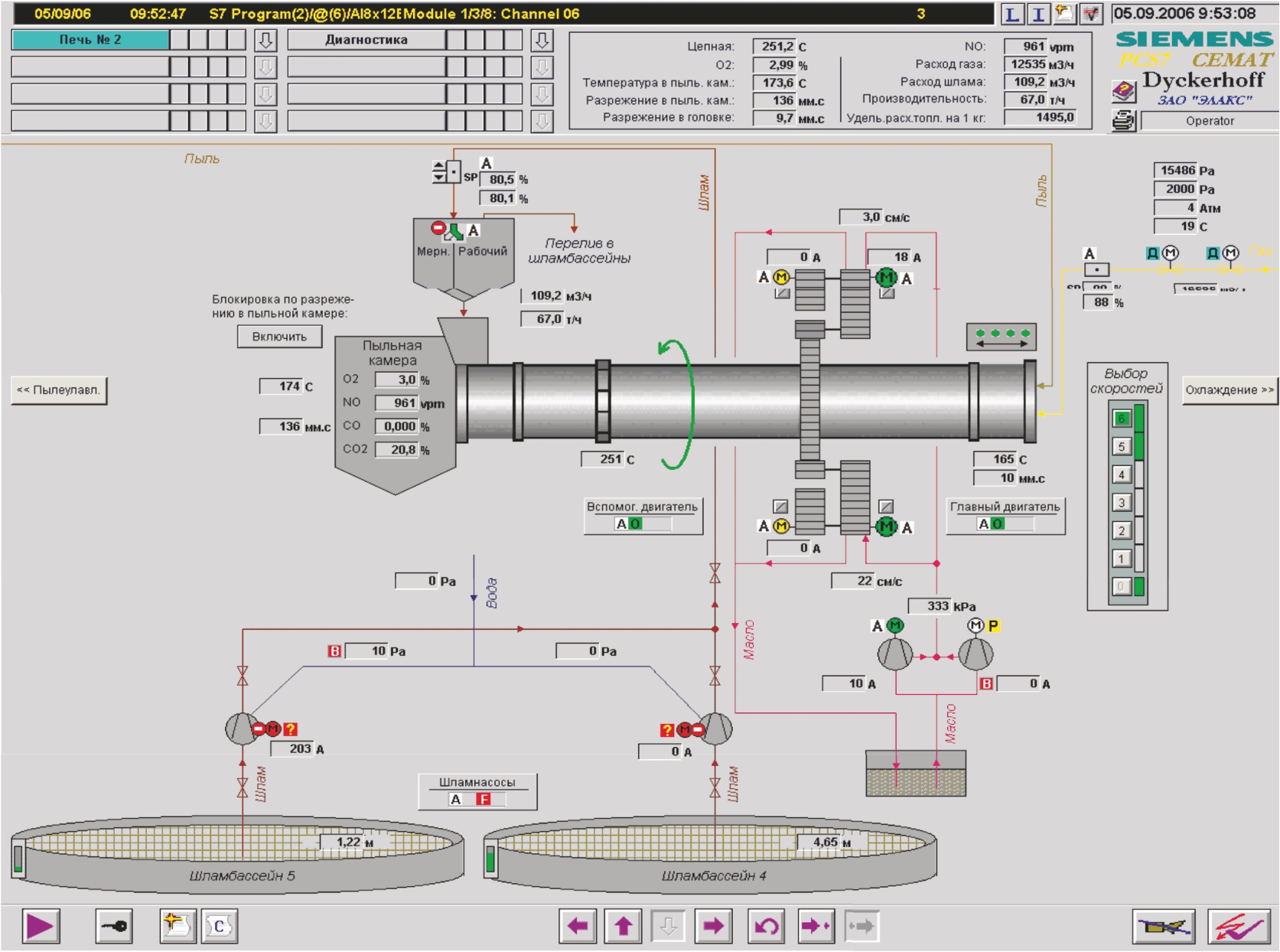
Process automation of clinker manufacturing involves the following operations and equipment (one of DYCKERHOFF plants is taken as an example):
- slurry pump and 2 slurry tanks;
- kiln feeding system (5x185 m); suction fans, electric filters;
- dust precipitating system;
- primary and supplementary electric drives of the kiln;
- gas burner;
- clinker refrigerator;
- clinker transportation and feeding into silo.
The scope of works performed:
- Prepare technical drawings for the power equipment, measuring devices and sensors, processes automation hardware and software;
- Manufacture control cabinets with programmable logic controllers and electric power equipment;
- Install measuring devices, sensors and actuators;
- Provide on-site supervision, field wiring, start-up works, commissioning and maintenance;
- Personnel training.
Industrial automation systems that control the electric drives are configured on the basis of electrical machinery and software products produced by Siemens. Two-level integrated automation system is powered by Industrial Ethernet fiber optic loop. Simatic PCs are used as workstations, and Simatic S7-400 programmable logical controllers are applied as basic computing and control devices. Controllers are equipped with ЕТ200М distributed i/o stations based on Profibus DP fiber optic looped networks. The system also includes OSM and OLM optic switching modules.
Visualization and process control are based on Cemat software which is preconfigured for cement industry and makes part of Simatic Process Control System 7. Terminal Data server integrates information about all the processes and systems. Adjustable electric drives work on the basis of Schneider-made Altivar frequency converters controlled with the help of Profibus DP bus. All meters and sensors that measure temperature, pressure, flow, and consumption are Siemens products.
Depending on the customer’s requirements, we can also develop applications based on electric drives, controls, and actuators (automatic breakers, electric contactors, thermal relays) produced by Ukrainian manufacturers.
Our other implemented projects use applications based on electric drives and actuators (automatic breakers, electric contactors, thermal relays) manufactured either by Siemens and Schneider or by Ukrainian producers, depending on the customer’s requirements.
Visualization systems rely either on Siemens-made WinCC software or on InTouch software developed by Wonderware.
Control functions
Electric drives and actuators run under several control modes:
- Local maintenance control without blocking;
- Remote and automatic interlocked control from the computer screen;
- Automatic control of the following parameters and operations:
The amount of raw materials fed into the kiln;
The amount of gas fed into the burner;
The speed of the rotary kiln;
The performance of clinker coolers controlled by frequency converters via the open-loop automatic control system.
The operating modes are selected at the computer and confirmed at the local control panels.
Calculation functions
The system calculates the following parameters from the beginning of the control period (e.g. shift, day, month, year) or for the entire control period:
- The amount of raw materials fed into the kiln;
- The amount of clinker produced;
- The amount of consumed gas and compressed air;
- Energy consumption
- Rotation speed of the kiln at different modes
Safety functions (blocking)
In case of emergency, the following safety measures are taken:
- The automation control system cuts off the gas when the gas pressure is higher or lower than the predetermined parameters, or when the pressure in the flue dust chamber drops lower than the required value.
- If the pre-start alarm system fails to give an audible alarm or if there is no time delay for the audible signal when it’s due, the operator can block the starting impulse if the mechanism is not clearly visible. This is possible under any type of control.
- The electric drive can be stopped by pressing the Stop button next to the drive.
- The conveyor belt can be stopped if the lanyard switch goes off.
- Electric drives equipped with velocity sensors can be stopped if the sensor fails to send any signal after the drive is started.
- Once an electric drive is blocked, other connected drives can be stopped as well.
- Raw materials feeding is blocked when the gas is cut off or when the rotary kiln drive is stopped.